Standing in a World That Still Has Bison
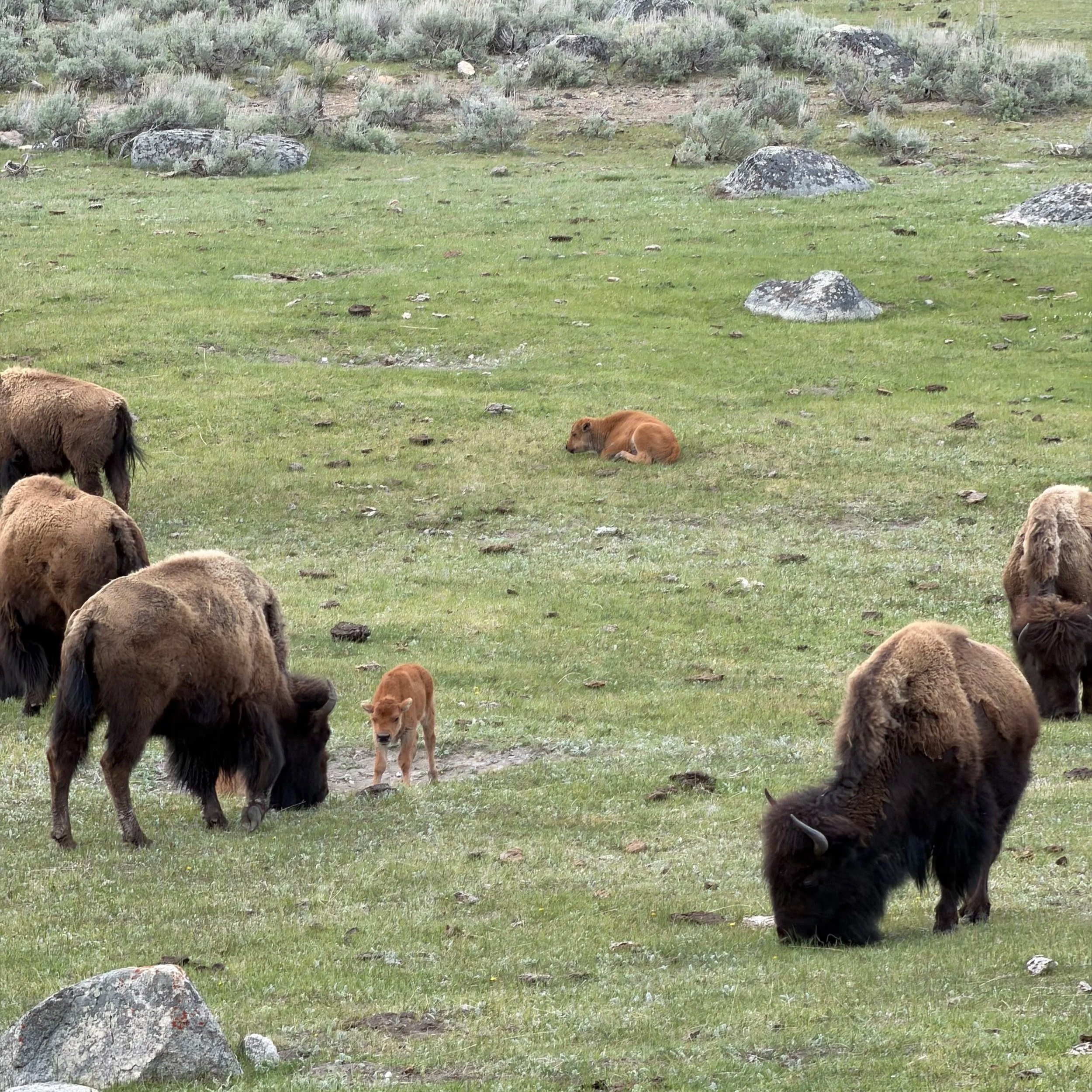
Bison with two calves in Yellowstone National Park. Photo taken by Elizabeth Benzinger in the spring of 2026.
I think most people in the US, and even more so those of us fortunate enough to live in states bordering Yellowstone National Park, tend to take for granted the fact that we can easily access and view massive and flourishing herds of bison.
According to the National Park Service, “Railways, rifles, and an international market for buffalo hides led to “the Great Slaughter” from about 1820 to 1880, when the bison population plummeted from 30-60 million (estimates vary) to fewer than 1,000 animals by the 1890s. Other factors including the military’s directive to destroy buffalo as a way to control American Indians, the introduction of diseases from cattle, drought, and competition from domestic livestock (horses, cattle, sheep) contributed to the reduction in bison numbers as well. At their lowest numbers, some estimated that there were only 300 bison that survived the slaughter, bringing the species to the brink of extinction.”
Less than 150 years ago, people were estimating that there might have only been 300 bison in the United States. Now while there are an estimated 15,000 wild bison in the United States, there are more than 500,000 in the US living on ranches and roaming wild.
The modern day success of the bison species in the US is in large part due to utilizing cow genetics to help return the species to where it is now. Stanford University states, “There are 500,000 bison in the country today and another 160,000 or so in Canada. Most of these herds are the result of interbreeding with cattle and are managed like livestock, raised on the range then spending their last months in feedlots. About three percent – 11,000 in the U.S. and 13,000 in Canada – are nearly pure-bred – descendants of the 60 million animals hunted almost to extinction in the late 19th century to feed industrial demand for hides and the government’s desire to debilitate tribes depending on them.”
All of this data and information and the statistics are all to say; we are incredibly fortunate to exist in a world with bison. When we travel to Yellowstone, the crowds (and admittedly, us too) are searching for the predators. We want to see the grizzlies, the black bears, the wolves! We want to see these big, impressive predators so badly that at some point we got to the point where we don’t stop to photograph the bison; we continue on and follow the crowds hoping to catch a glimpse of a wolf from the top of a ridge.
Wild Perch Co is about slowing down; about stopping to appreciate everything around us. The entire brand is about pausing to see the big and small, predator and prey. Realizing just how fortunate we are to exist at the same time as massive herds of bison when only 150 years ago they were on the brink of extinction is a powerful thing.
A Nature Prescription
What if we prescribed ourselves the things that recharge our nervous systems?
We crave nature. We crave any connection to it we can possibly find. We crave a connection to nature so much that we bring it indoors through any means possible. We set up aquariums in our homes, we watch nature documentaries, we fall asleep to “thunderstorm sounds,” or in my case, “Black screen 12 hours crickets frogs nature creek sounds guaranteed to make sleep more restful!”
This week I had a perspective shift. My therapist and I were talking through, brainstorming, round-tabling, if you will — “Elizabeth you can give me one hundred examples of the things you give your energy to on a daily basis. How often do you consider what activities are giving YOU energy? Or what activities are even helping to conserve your energy if not replenishing it?”
First of all… lower your voice? After searching for a therapist that would actually challenge me, how dare she actually challenge me?
In all seriousness though, she’s right. In the rat race of it all, every Monday morning I lose sight of what refills my cup and replenishes my (already low) energy stores. Avery and I spend our weekends filled with wanderlust and late night conversations of, “What if we just quit our jobs and put all our time and energy into actually living?” Yet every Monday morning I’m off to the races again. Wake up, find a socially acceptable and presentable outfit, commute 15 minutes to work, smile, be social, don’t talk too much about your aquariums or birds of prey or the collection of animal bones in your trunk, make eye contact but not too much, listen and don’t interrupt, get all your tasks done, be productive, show the bosses you’re useful and an asset, commute 15 minutes home, walk the dogs, try to remember to feed yourself, crash and nap for two hours, wake up disoriented at 9pm, doom scroll on TikTok for an hour or four, go to sleep for real this time, wake up to your “Up All Night” by Mac Miller alarm and repeat.
So this week my perspective shifted. I told my therapist that the idea of scheduling time for myself seems impossible; it makes me feel guilty for taking time away from “more important” things. I joked that the only way that might work would be if I viewed it like any of my other prescriptions. I paused and thought about that for a moment and I’ve been thinking about it most of my waking hours since then. I take meds for my brain chemistry, for my auto-immune disease, vitamins for my body to function its best. What if I prescribed myself a “medication” to refill my own cup?
We broke it down. She asked, where is your energy going currently and more specifically where are you overexerting yourself? My answer was essentially a 50/50 split between my 9-5 and home life (which encompasses feeding myself, caring for pets, household chores, etc). So naturally in typical therapy fashion, the next step was, “Well in an ideal world, what would that pie chart of energy exertion look like?” What a loaded question, doc… obviously I’d want to quit my job and frolic in the woods and eat nice cheeses without the negative impacts of lactose on my GI tract.
I’ll spare you the monologue, but at the end of the day what I narrowed it down to is that really the only things that I can consistently count on to refill my own cup involve immersing myself in our natural world.
My specifics came down to:
Walking through the woods slowly; observing and listening and paying attention to everything I can see, hear, feel. Stopping to flip over a log or a rock to see if any critters are hiding underneath. Standing perfectly still until I can hear the wind in the trees, hear the beetles moving the leaf litter.
Spending time quietly in or near natural bodies of water. I prefer the ocean, but the love of my life moved us to a land locked state, so the complex river systems and mountain lakes of Southwest Montana will do just fine.
So that’s the case for me. This week and in the weeks to come, I’m prescribing myself an immersion in nature. If that’s 5 minutes sitting underneath a tree outside my job, great. If that’s an hour walking through a half-dried up riverbed looking for cool rocks, wonderful. I’m starting small and setting a goal of doing this at least twice a week. I want to be as present as possible and really allow my nervous system the space to breathe and relax and reset in these calming, safe spaces.
I look forward to reporting back with how this new prescription works out for me both mentally and physically, and I challenge you to do the same. Even if it’s just one time and you never return to it, this week I challenge you to spend at least 10 minutes quietly outdoors. Try and use each of your five senses in that time and allow yourself the space to decompress as much as you’re able to from the oppressive routine of overworking yourself that far too many of us have normalized. Let me know how it goes.
Liz